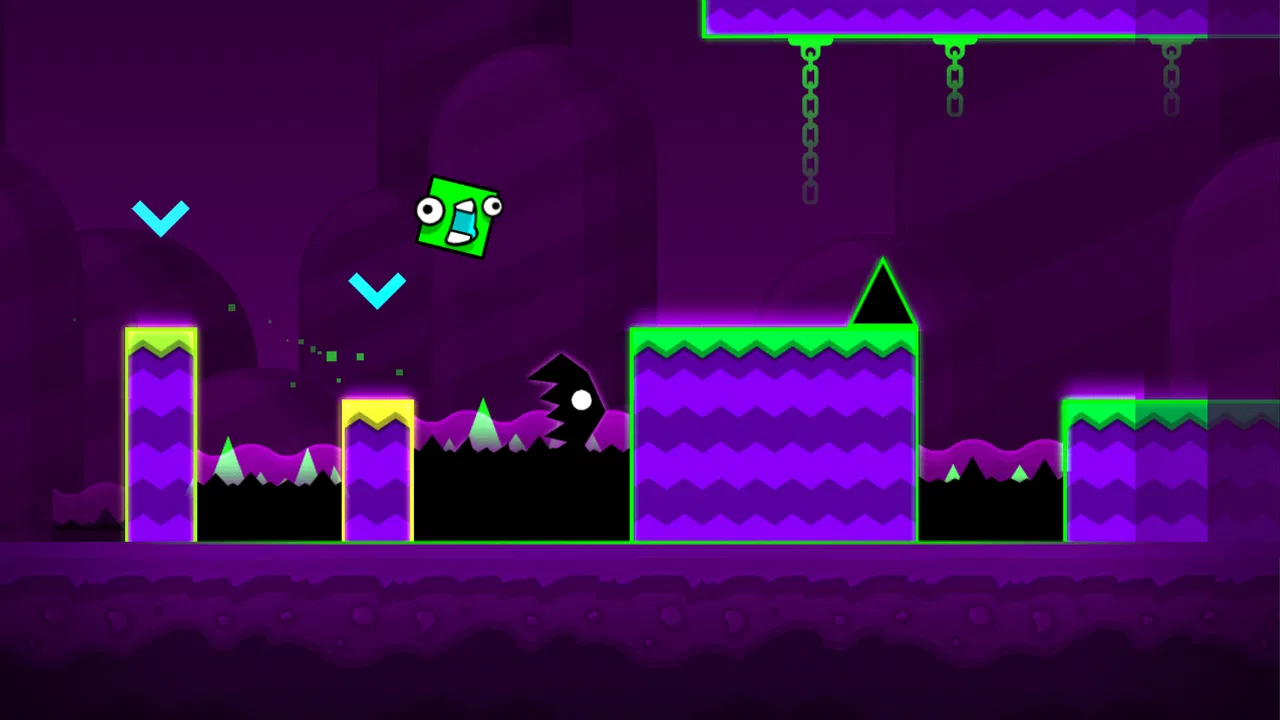
Geometry Dash World
- 4.5
- Rating
- 100.00M
- Installs
- Free
- Price

 Analysis by App-foxy
I first understood the appeal of Geometry Dash World after a very short attempt: the character moved forward, I tapped to jump, I mistimed one obstacle, and the level immediately sent me back to try again. That sounds simple, but the timing creates a surprisingly strong pull. Every failure tells me exactly what went wrong, while every successful jump makes the next few seconds feel earned. It is an arcade game built around action, feedback, reward, reset, and the question that keeps the loop alive: can I do it cleanly on the next attempt?
Developed by RobTop Games, this is a rhythm-focused action platformer for players who enjoy quick reactions more than long explanations. It is free to play, aimed at Everyone 10+, and works on devices running Android 6.0 or later. The game has been available since December 22, 2016, and its current version is 2.2.147. Those details matter less than the way it feels in the hand, but they also explain why it remains easy to recommend to someone looking for a compact game that can fill a few spare minutes without demanding a long setup.
Why each attempt feels like a small challenge
I like how each attempt gives me one clear thing to notice: whether I reacted too early, too late, or lost the rhythm of a familiar sequence. That makes even a brief session useful, especially if I focus on one obstacle instead of demanding a perfect run. From there, it’s worth looking at how the simple controls turn that focused practice into the game’s central challenge.
You May Also Like

 Blood Strike: 2.5 Anniversary
Blood Strike’s Loadouts Turn Every Drop Into a Tactical Gamble
A close look at Blood Strike’s custom loadouts: how fast access to signature weapons reshapes its battle royale rhythm, rewards preparation, and narrows the gap between fights.

 Pandora - Music & Podcasts
Pandora’s Music Is Easy to Start, but Harder to Recover
Pandora’s strength is its low-effort path from a seed to a station. Its weak spot is how much confidence it asks you to place in connection, setup, and quiet recovery.

 8 Ball Pool
 Is Built on Rivalries, Rematches, and Routine
A close look at the rivalries, rematches, shared routines, and unanswered safety questions that turn a quick pool match into a persistent mobile community.

 Samsung Music
’s Quiet Strength Is Playing What You Already Own
Its reach comes less from spectacle than from dependable access to a personal library. That simplicity is both the app’s strongest retention engine and its ceiling.

 AccuWeather: Weather Radar
AccuWeather Review: A Quick, Clear Forecast for Everyday Decisions
For everyday plans, the best forecast is the one you can understand quickly. AccuWeather makes rain timing, radar, and local conditions easy to act on, with a few trade-offs.

 Hill Climb Racing
Why Hill Climb Racing Still Turns Crashes Into One More Run
A tiny car, a bumpy hill and one more upgrade: Hill Climb Racing keeps resurfacing because its simple chaos makes every near-miss feel personal.
More From Our News Desk



The first action is simple, but the timing is not
The basic control is wonderfully direct. I tap to make the character jump or react to the level, then concentrate on the path ahead. There is no complicated control scheme to memorize before the game becomes enjoyable. The challenge comes from reading the shapes, anticipating gaps, and pressing at the right moment. Because the character keeps moving, hesitation is often just as dangerous as a late reaction.
This is where the game differs from a slower platformer. I am not carefully exploring a large map or choosing between several routes in the middle of a jump. The level presents a sequence of hazards, and my job is to recognize its visual rhythm quickly enough to respond. The strongest moments happen when my hands begin to follow the pattern before I consciously describe it. A jump that looked impossible during the first attempt can become almost automatic after several focused tries.
The presentation helps make those reactions readable. Obstacles are arranged as part of a clear visual pattern, and the movement is closely tied to the music. I found that listening matters, even when I am mainly watching the screen. The beat can help me anticipate a change, but it is not a substitute for attention. A familiar section may feel easy with sound, yet one careless tap can still end the run.
That immediate control also makes the game suitable for short sessions. I can play while waiting for an appointment, during a brief break, or when I want something more active than a passive time-killer. A single attempt may end quickly, but it rarely feels wasted because the restart is immediate and the mistake is still fresh in my mind.
Feedback turns mistakes into useful information
The feedback is the heart of the experience. When I hit an obstacle, the result is unmistakable. There is no uncertainty about whether the game registered my input or whether a hidden rule caused the failure. I either cleared the hazard or I did not. That clarity makes repeated attempts feel fairer than they might in a game where defeat arrives without an obvious explanation.
At the same time, the game is not generous about sloppy timing. A tap that is only slightly early or late can ruin a sequence, particularly when several hazards appear close together. This creates a useful tension: I am always learning the level, but I am also training my own consistency. Memorizing the order of obstacles helps, yet memory alone will not carry me through if my taps are uneven.
I recommend playing with a steady grip and avoiding frantic tapping. Rapid, nervous inputs usually make the timing worse. A better approach is to watch one section at a time, identify the next landing point, and let the rhythm guide the spacing between taps. This is one of the less obvious strengths of the game: improvement comes not only from faster reactions, but from becoming calmer.
For anyone wondering whether the game requires sound, I would say it is playable without it, but the experience is stronger with audio. The musical timing gives each action more context and makes repeated sections less mechanical. If I am in a noisy place, I can still focus on the visual cues, though I lose some of the natural rhythm that helps connect one jump to the next.
The reward is progress I can feel, not just a result screen
Geometry Dash World rewards persistence in a very personal way. The satisfying moment is not limited to finishing a stage. I also notice progress when I reach an obstacle that previously stopped me, survive a longer sequence, or finally connect two difficult sections. The game keeps turning small improvements into reasons to continue.
That reward structure works because the attempts are short and the objective is concrete. I am not waiting for a long loading sequence or replaying a large section after one mistake. I can immediately test the adjustment I just made. If I jumped too late, I try earlier. If I rushed a sequence, I slow down. The distance I gain becomes evidence that the change worked.
There is also a useful difference between knowing a level and mastering it. After enough attempts, I may remember where the hazards appear, but that does not guarantee a clean run. The game asks me to combine recognition with execution. That makes success feel more meaningful than simply discovering a solution once.
For a casual player, this can be a pleasant five-minute challenge. For a more determined player, it can become a focused practice routine. I sometimes set a small personal target, such as reaching one section farther than before, rather than demanding a complete run. That approach keeps the game enjoyable and prevents a difficult level from turning into an exhausting test of patience.
The broad audience is reflected in its popularity. The game holds a 4.5 average from around 1.3 million ratings, with roughly 65 thousand written reviews and over 100 million installs. Those figures do not guarantee that every player will enjoy its strict timing, but they do show how well the compact retry-based format has connected with a large audience.
Resetting is part of the design, not a punishment
The reset is almost as important as the jump. When a run ends, I am back at the beginning quickly enough to remember the exact mistake. That keeps frustration from becoming passive waiting. I am not forced to spend a long time recovering from failure; I simply decide whether I want to apply what I learned.
Still, the reset loop is not for everyone. Players who prefer relaxed exploration, forgiving checkpoints, or a story that steadily unfolds may find the repetition tiring. The game asks me to accept that a familiar section must be replayed before I can practice the part that defeated me. That is a real trade-off. The restart is fast, but the road to a difficult section can still become repetitive.
My best results came from treating each failed run as a short experiment rather than a verdict. If I kept making the same mistake, I stopped tapping harder and changed my attention instead. Sometimes I watched the next obstacle rather than the character. Other times I focused on the beat and tried to make my input more deliberate. This small change in mindset matters because the game can punish emotional reactions more severely than slow, thoughtful practice.
A practical everyday scenario shows the design clearly. Imagine having a few minutes before a train arrives. I can launch the game, attempt a level, fail near a familiar section, and restart without losing the whole break to menus. If the train arrives, I can stop immediately. If I have more time, one successful jump may lead to another attempt because I know the next run could finally pass the section that blocked me.
How it compares with other arcade choices
Compared with endless runners, this game feels more deliberate. An endless runner often emphasizes staying alive as the speed or distance increases, while this experience makes the arrangement of hazards and the timing of each input the main event. I am not simply reacting to a stream that changes continuously; I am learning a designed sequence and trying to execute it accurately.
Compared with traditional platform games, it is less about exploration and more about precision. There is little room for wandering around to find a safer route. That focus makes it easier to understand but harder to master. Someone who wants a large world, character development, or a slower sense of discovery would probably be better served elsewhere. Someone who wants a clear challenge that begins immediately may prefer this format.
It also has a different feel from casual puzzle games. Puzzle games usually reward planning before action, whereas this one asks me to make decisions in motion. I can learn the pattern, but I still need the right physical timing. That makes it a good alternative when I want my attention and reflexes involved rather than only my ability to reason through a static problem.
The most important comparison is with other rhythm games. Here, the music supports the action, but the level geometry remains essential. I am not merely matching beats in isolation. I am using the beat, the visual layout, and the movement of the character together. That combination gives the game its identity and explains why a familiar song-like pattern can make a difficult section feel more readable.
Who will enjoy the challenge, and who should skip it
I would recommend it to players who like short arcade sessions, clear rules, and visible improvement. It suits people who enjoy retrying a difficult sequence without needing a large reward system around it. It is also a good choice for anyone who appreciates games that are easy to start but demand patience after the first few minutes.
I would be more cautious about recommending it to someone who becomes irritated by repeating the same opening section. The game does not soften its central idea to make every attempt comfortable. Precision is the point, and failure is frequent when learning. If you want a calming game for winding down, the energetic rhythm and strict timing may have the opposite effect.
Parents should also remember that the age guidance is Everyone 10+. The presentation is colorful and accessible, but the difficulty can encourage persistent replay. For younger players, it may be worth setting a natural stopping point rather than treating every level as something that must be completed in one sitting.
Small habits that make difficult sections manageable
One useful habit is to separate recognition from reaction. On an early attempt, I watch where the obstacles appear and notice whether I am consistently failing before or after a particular visual cue. On the next attempt, I focus on correcting only that moment. Trying to fix every mistake at once usually creates more confusion.
Another tip is to keep the device stable. Because a single tap can determine the outcome, even a casual grip can make the controls feel less consistent. I prefer holding the phone securely and using the same finger position throughout a session. This is not a hidden power-up or a special technique; it is simply a way to remove unnecessary variation from a game that already demands precise timing.
I also found it helpful to stop after a run in which my concentration clearly dropped. The fast restart makes it tempting to continue automatically, but tired attempts often teach bad timing. A short pause can be more productive than ten unfocused retries. When I return, the familiar pattern is still there, but my reactions are less rushed.
Finally, I avoid measuring a session only by completion. Reaching a new point, surviving a previously troublesome jump, or understanding why a sequence works can all count as progress. That perspective keeps the reward loop healthy. Otherwise, the game can feel like a wall; with smaller goals, it feels like a series of reachable steps.
My verdict on the complete action loop
Geometry Dash World succeeds because every part of its loop supports the next attempt. The first tap is easy to understand, the feedback is immediate, the reward is visible in improved distance, and the reset removes most of the delay between failure and learning. I rarely wonder what I am supposed to do. The real question is whether I can perform the action with enough consistency.
That clarity is also its limitation. There is no escaping the repetition, and the strict timing can feel demanding when I want something more forgiving. The game is not the right choice for exploration, narrative, or relaxed progress. It is a focused arcade challenge, and its appeal depends on whether the player enjoys turning mistakes into practice.
For me, the strongest reason to keep it installed is the way a failed run remains useful. I can put the phone down after a few attempts, return later, and immediately understand the challenge again. The game does not need a long session to make progress feel real. Its free price makes that easy to try, while the large player base suggests that the formula has lasting appeal.
My final recommendation is straightforward: choose it if you want rhythm, reflexes, and an honest retry loop in a compact arcade package. Skip it if repeated failure feels more stressful than satisfying. When the timing clicks, another session begins almost by itself—not because the game hides what comes next, but because I know exactly what I need to improve.
FAQs for Geometry Dash World
01What is Geometry Dash World, and how does it differ from the original Geometry Dash?
Geometry Dash World is a rhythm-based platformer game that offers players a series of unique levels with vibrant graphics and catchy soundtracks. Unlike the original Geometry Dash, this version includes shorter levels and introduces new gameplay mechanics. It serves as a great way to familiarize yourself with the game’s style and controls before tackling the more challenging original game.
02Is Geometry Dash World free to play, and are there in-app purchases?
Geometry Dash World is free to download and play, making it accessible to a broad range of users. However, the game includes optional in-app purchases, such as removing ads or unlocking additional content. These purchases are not necessary to enjoy the full experience but can enhance gameplay and convenience.
03Can I play Geometry Dash World offline, or is an internet connection required?
Geometry Dash World can be played offline, allowing you to enjoy the game without an internet connection. However, certain features, such as leaderboards and downloading user-generated levels, require an online connection. Playing offline won't hinder your ability to progress through the main levels.
04What are the system requirements for Geometry Dash World on Android and iOS devices?
Geometry Dash World is designed to be compatible with most modern Android and iOS devices. It requires Android 4.0 or later and iOS 8.0 or later to run smoothly. The game is optimized for both smartphones and tablets, ensuring a seamless experience across different screen sizes.
05How can I customize my character in Geometry Dash World?
In Geometry Dash World, players can customize their character by unlocking different icons and colors as they progress through the game. These customizations are purely cosmetic and do not affect gameplay. Unlocking items can be achieved by completing levels, achieving certain milestones, or finding hidden secrets within the game.
Pros
- Engaging and challenging gameplay.
- Vibrant graphics enhance experience.
- Variety of levels and soundtracks.
- Responsive controls for precise jumps.
- Frequent updates with new content.
Cons
- Can be frustratingly difficult.
- Advertisements interrupt gameplay.
- Limited free levels available.
- Requires internet for some features.
- In-app purchases can add up.

Geometry Dash World
Gallery